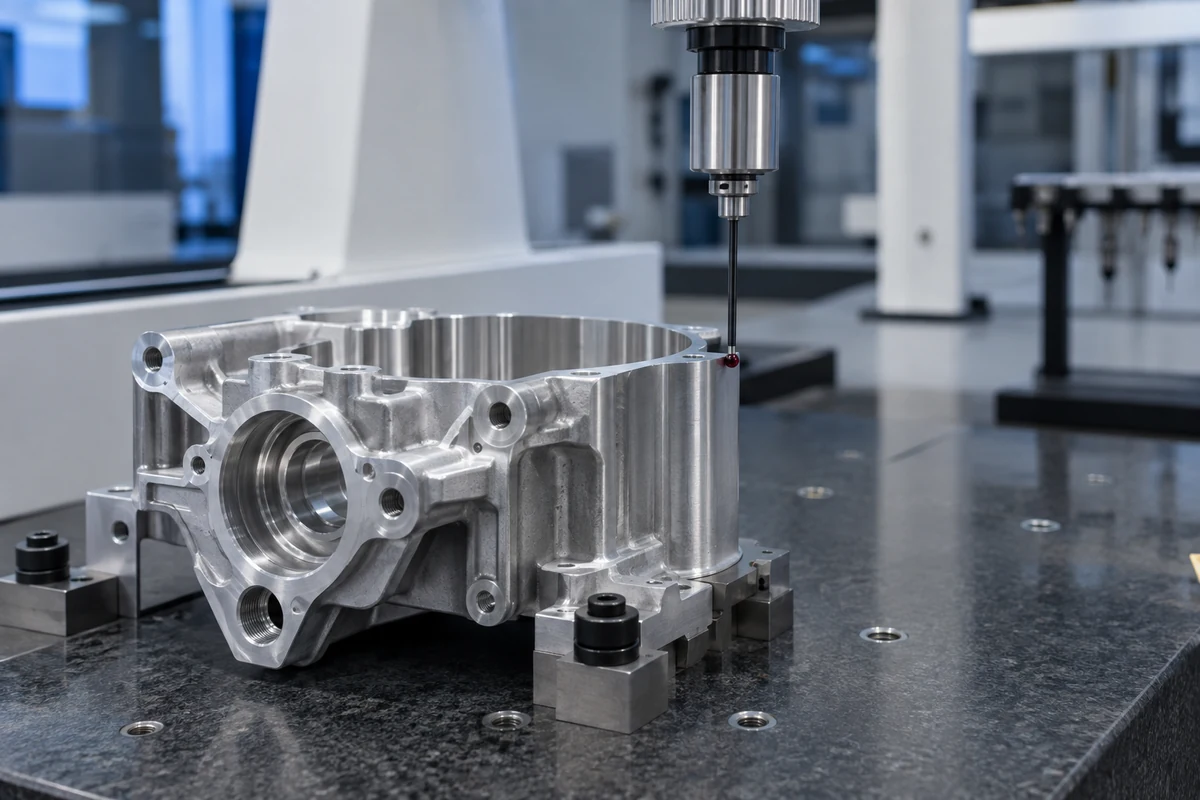
Request a drawing-linked inspection plan and report, a defined datum alignment, suitable calibrated measurement methods and material or lot identification. Metrological traceability concerns a measurement result and its uncertainty, not merely a sticker on an instrument.
Key takeaways
- Agree the characteristics, sampling and acceptance decision before production.
- Separate material-lot traceability from metrological traceability.
- Request results with enough context to understand the method and uncertainty.
1. Start with the acceptance decision
Number the drawing characteristics and agree which require first-article, in-process or final inspection. Define the sampling plan, units, final surface condition and report format. Ask how borderline results and nonconforming parts will be handled. A long list of dimensions is less useful than a plan tied to the features that control function.
Choose the method for the characteristic. A CMM can assess many geometric relationships; a thread gauge, micrometer or surface-texture instrument may be more appropriate for other requirements. Agree the required measurement capability rather than assuming that one machine proves every feature.
2. Make the CMM setup reproducible
Record the part orientation, fixture, datum alignment, probe configuration and programme revision. Clean the workpiece and stylus. Renishaw's sensor guidance explains why qualification conditions must be consistent with the measurement cycle; its SP80 guidance also stresses correct calibration, cleanliness and system checks. These are instrument-specific references, not a universal probing recipe. [2] [4]
Account for temperature and allow the setup to stabilise as required by the measurement procedure. Renishaw advises avoiding unnecessary temperature changes and operating close to calibrated conditions when using its compensation system. Record relevant conditions rather than assuming that compensation removes every thermal effect. [3]
3. Keep two kinds of traceability distinct
Material traceability connects a component or lot to material and processing records. Metrological traceability connects a measurement result to a reference through a documented calibration chain with uncertainty contributions. NIST explicitly explains that a calibrated instrument alone does not make every subsequent result traceable. [1]
Ask for the equipment identifier, relevant calibration status and the uncertainty or measurement-capability information needed for the acceptance decision. Keep the drawing revision and lot or serial reference with the report so the evidence cannot silently migrate to another part.
4. Request a proportionate release package
For a routine bracket, an agreed dimensional report and material record may be sufficient. A more demanding project may need a formal first-article package, approved process records or external laboratory results. Specify those deliverables when quoting; adding them after production can leave missing evidence.
ISO/IEC 17025 concerns competence and consistent operation of testing and calibration laboratories. If accredited work is required, verify the laboratory's scope against the requested measurement. A standard name or logo does not establish the capability needed for your part, and this demo makes no certification claim. [5]
- Link each reported result to a drawing characteristic and unit.
- Identify the part revision, lot and report date.
- Record deviations and the authorised disposition before shipment.
Answers before you start.
No. Conformance also depends on the measurement method, setup, conditions, uncertainty and agreed acceptance rule.
Authoritative references
- Metrological Traceability: Frequently Asked Questions and NIST PolicyNIST
- Educational article — The sensorsRenishaw
- Temperature compensationRenishaw
- Maximising performance — SP80/SP80HRenishaw
- ISO/IEC 17025:2017 — Testing and calibration laboratoriesISO
Engineering guidance for project preparation. Confirm drawing, material and acceptance requirements for your application.