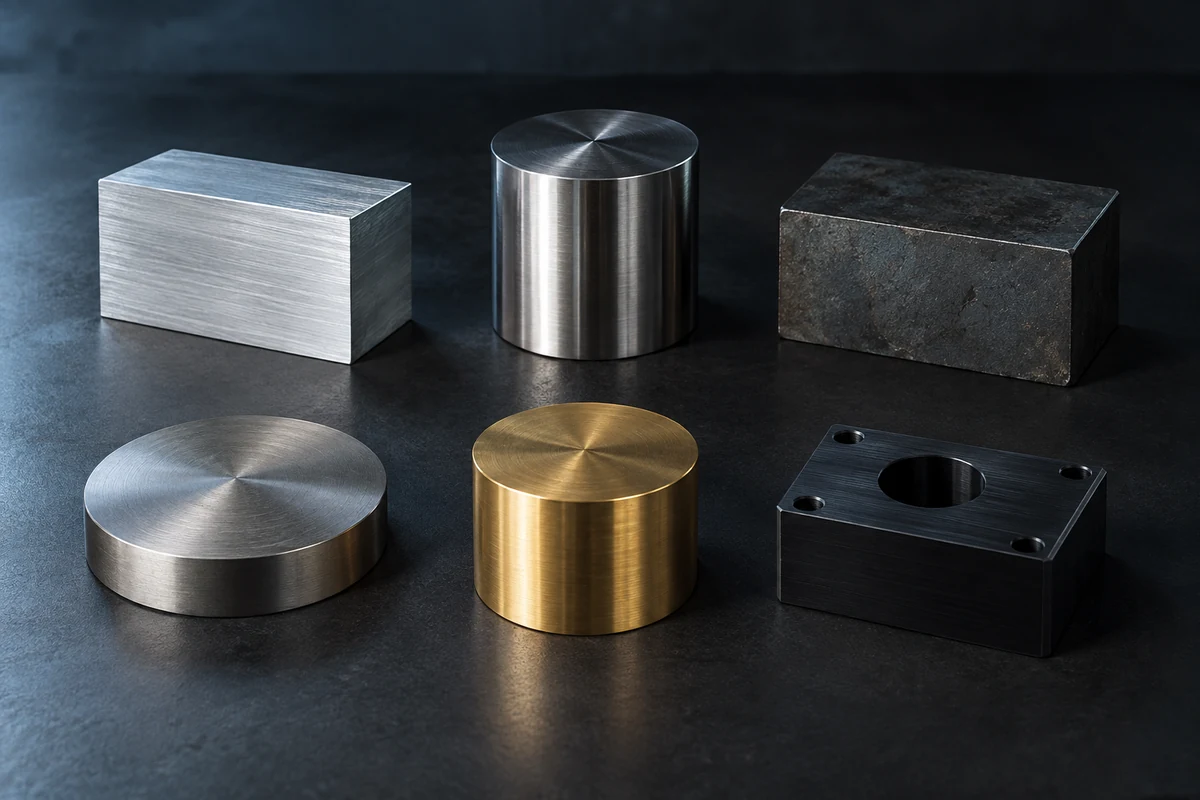
Choose material from the service environment and functional requirement, then specify the alloy, condition and product form. Compare 6061 for balanced fabrication needs, 7075 when strength drives selection, and stainless grades against the actual corrosion exposure.
Key takeaways
- Alloy names alone do not define mechanical properties.
- Temper, product form and finish must accompany the grade.
- Request material evidence and approve substitutions before ordering.
1. Write the service requirements first
Start with load cases, operating temperature, exposure to fluids or chlorides, mass limits, joining method and the surfaces that must remain dimensionally stable. Identify any customer or regulatory material specification. A supplier can suggest options, but an alloy substitution needs the design owner's approval.
Create a short comparison sheet with the property that controls the design, the exact stock specification, finish and certificate requirement. Compare like product forms and conditions. A typical value in a producer's brochure is not a guaranteed allowable for every machined part.
2. Compare 6061 and 7075 with the temper included
Hydro describes 6061 as a medium-strength, heat-treatable alloy with useful corrosion resistance, weldability and anodising options. It distinguishes conditions including T6 and stress-relieved T651, and notes that welding changes strength. This makes 6061 a useful candidate when fabrication, joining and moderate structural requirements must be balanced. [1]
7075 is a candidate when strength is a stronger selection driver, but the temper and exposure still matter. Kaiser's tube-and-pipe data distinguishes T6 from T73 and reports improved stress-corrosion resistance for T73. That document covers its stated product form; do not transfer its property table directly to plate, bar or a different procurement specification. [2]
Before choosing either alloy, ask whether the proposed stock condition, machining sequence and final finish support the part's geometry and assembly requirements. Avoid replacing an engineering calculation with the phrase 'aerospace-grade'.
3. Review stainless steel against the environment
Specify the stainless grade rather than simply 'stainless steel'. Outokumpu identifies 316L/1.4404 as a low-carbon, molybdenum-alloyed austenitic grade and explains its suitability for increased corrosion demands. The low-carbon condition matters particularly where welding is involved. [3]
Molybdenum can improve resistance to pitting and crevice corrosion, but no grade is automatically suitable for every chloride environment. Outokumpu also cautions that a calculated pitting-resistance index does not predict behaviour in a real installation. Consider temperature, concentration, deposits, crevices and cleaning chemicals; seek application-specific corrosion data. [4]
4. Put the decision into the enquiry
Record the grade, temper or heat-treatment condition, product form and applicable specification. State whether material certificates, heat references and finishing records are required. Identify prohibited substitutions and confirm stock availability before committing to a schedule.
- Request the material producer's data for the supplied form and condition.
- Confirm finish compatibility, masking and dimensional acceptance.
- Have the responsible engineer approve the final material selection.
Answers before you start.
No. Selection also depends on joining, environment, temper, product form, design requirements and availability. Higher strength alone does not establish suitability.
Authoritative references
- 6061 AluminumHydro
- Tube & Pipe Alloy 7075 — Technical DataKaiser Aluminum
- Supra range — 316L/4404Outokumpu
- What makes stainless steel corrosion resistant?Outokumpu
Engineering guidance for project preparation. Confirm drawing, material and acceptance requirements for your application.